

Photo: FOX5 DC
How Texas Troops Ended Up in Chicago—and What It Tells Us About the Politics of Federal Power
A tragic shooting in Washington, D.C. this week underscores the risks facing National Guard members deployed to American cities. As one West Virginia guardsman died and another fights for his life, questions mount about how these deployments serve public safety—or political ambitions.
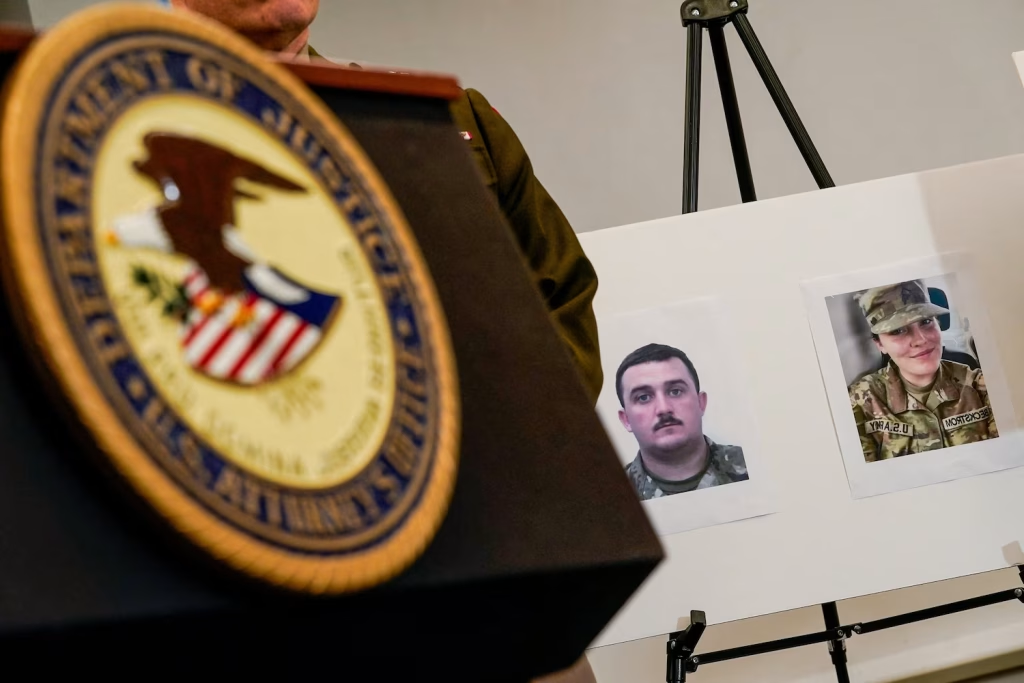
The ambush near the White House was brutally efficient. A gunman approached three West Virginia National Guard members who appeared not to see him until he began shooting. Army Specialist Sarah Beckstrom, 20, died from her wounds on Thanksgiving Day. Staff Sergeant Andrew Wolfe, 24, remains in critical condition. Both were citizen-soldiers who had volunteered to work the holiday while deployed as part of President Trump’s federal takeover of Washington, D.C.’s streets—a deployment that began in August as part of Trump’s crime crackdown.
Jim Seward is the Major General Adjutant General for the West Virginia National Guard:
Today’s events have brought an extremely somber and serious tone to this Thanksgiving. Two of our West Virginia National Guardsmen were shot in our nation’s capital while performing their duties ensuring the safety and security of the citizens of the District of Columbia.
This brutal attack was senseless and entirely unprovoked. In times like these, my thoughts not only linger on those brave Guardsmen but also their families, friends, and their fellow service members. I would like to extend my profound gratitude to the first responders, doctors, and nurses who cared for our members.
I am thankful for the swift action taken by the courageous fellow West Virginia National Guardsmen who quickly engaged and neutralized the assailant, saving lives. Further, we are overwhelmed at the outpouring of prayers from civilian and military leaders, as well as individuals throughout West Virginia and the nation.
I ask that you continue to pray and to hold your loved ones close this Thanksgiving. As Soldiers and Airmen, we defend this nation and serve our state with pride, professionalism, and patriotism. May God bless our One Guard Family, the great state of West Virginia, and the United States of America.”
The deadly attack crystallizes the controversial experiment playing out across American cities: deploying National Guard troops—typically reserved for natural disasters and wartime mobilization—as a visible presence on urban streets.

From Portland to Chicago to Memphis, the Trump administration has ordered or attempted to deploy Guard members to Democratic-led cities, justifying the moves as necessary to combat crime and protect federal property. Critics call it an unprecedented power grab that turns citizen-soldiers into a political prop.
The elite Texas National Guard.
— Greg Abbott (@GregAbbott_TX) October 7, 2025
Ever ready.
Deploying now. pic.twitter.com/7lXe7Wpmue
For Texans, the controversy hit home when Governor Greg Abbott authorized sending 400 Texas National Guard members to Illinois in early October, putting state troops on the streets of Chicago without the consent of Illinois Governor JB Pritzker.
I fully authorized the President to call up 400 members of the Texas National Guard to ensure safety for federal officials.
— Greg Abbott (@GregAbbott_TX) October 6, 2025
You can either fully enforce protection for federal employees or get out of the way and let Texas Guard do it.
No Guard can match the training, skill, and… https://t.co/7SUk9XlMBn
This evening, President Trump is ordering 400 members of the Texas National Guard for deployments to Illinois, Oregon, and other locations within the United States. No officials from the federal government called me directly to discuss or coordinate.
— Governor JB Pritzker (@GovPritzker) October 6, 2025
The deployment quickly became a legal, political, and financial flashpoint—one that may have damaged Abbott’s standing with voters while achieving little of its stated purpose.
The Chicago Gambit: Abbott’s Controversial Out-of-State Deployment
When Texas National Guard members boarded military aircraft on October 7th bound for Illinois, Abbott framed the mission in stark terms: Chicago could either fully enforce protection for federal employees or “get out of the way and let Texas Guard do it”. The deployment came at President Trump’s direction, ostensibly to protect Immigration and Customs Enforcement agents conducting raids in the Chicago area, where protests had sometimes turned confrontational.
The move was highly unusual. Governors rarely deploy their National Guard to another state without that state’s invitation—a principle rooted in respect for state sovereignty. Illinois officials reacted with fury. Governor Pritzker called it part of the Trump administration’s “authoritarian march” and vowed to use “every lever at our disposal to stop this power grab”.
The legal battles began immediately. Illinois and the city of Chicago filed lawsuits arguing the deployment violated constitutional protections and the Posse Comitatus Act, which restricts military involvement in domestic law enforcement. A federal judge ruled that while the Texas troops could remain in Illinois, they could not be activated for their intended mission pending resolution of the legal challenges. The case wound its way toward the Supreme Court.
But the deployment was already unraveling. Around 200 members from different units of the Texas Guard were in Illinois, federalized for an initial 60-day period under the command of U.S. Northern Command. Yet with their hands tied by court order, these troops sat largely idle while the deployment cost Texas taxpayers almost $3.5 million.

By late November, Abbott ordered the troops home before Thanksgiving, claiming the initial mission period had ended. The reality was less triumphant: the deployment had been legally blocked, publicly opposed by a majority of Texans, and had accomplished none of its stated objectives.
The Political Calculus That Backfired
If Abbott hoped the Illinois deployment would shore up his credentials with Trump’s base and demonstrate strong conservative leadership, polling data suggests the gambit backfired. A University of Texas survey found that 43% of Texans “strongly oppose” the move and 8% “somewhat oppose” it, while 41% supported the deployment.

More damaging to Abbott personally, his approval rating dropped to 39%, marking a 12-point decline from October the previous year and his lowest rating in a decade as governor.

While multiple factors likely contributed to this decline, the timing coincided with controversy over the Illinois deployment and broader questions about the use of National Guard troops for domestic law enforcement.
Even within Texas, the deployment sparked internal division. Ten Democratic Congress members from Texas demanded the immediate withdrawal of the state guards, calling the deployment unlawful and arguing it turned citizen-soldiers into a domestic police force. Some Republican officials also expressed concern. Oklahoma Governor Kevin Stitt, despite being a Trump ally, told the New York Times he opposed the move based on principles of states’ rights.
The political miscalculation extended beyond Texas. A plurality of Texans—49%—opposed the use of the U.S. military for law enforcement efforts in American cities, compared to 43% who supported it. Abbott appeared to have misjudged public sentiment on a fundamental question of civil-military relations.
What the Deployments Actually Accomplished—and What They Cost
To evaluate these National Guard deployments fairly, we must examine their stated purpose: reducing crime. In Washington, D.C., where the longest-running deployment has occurred, the picture is complex and contested.
Data shows D.C. saw 1,926 reported crimes from August 11 to September 9, an 18% reduction from both earlier that summer and the same period the previous year. The declines appeared most pronounced in robberies and motor vehicle thefts. Over the initial two-month period, shootings dropped 62% compared to the same timespan in 2024.
However, several critical caveats complicate claims that the Guard deployment caused these reductions. First, crime data analysis shows the steep downward trend in shootings predates Trump’s deployment by several months, with shootings plummeting beginning in mid-April. Second, Washington was already experiencing historic lows in violent crime before any troops arrived—a Department of Justice report from January showed total violent crime in 2024 was at its lowest level in more than 30 years.
Third, the deployments came with substantial costs beyond the daily million-dollar price tag for Guard operations. Tourism numbers declined, some restaurants struggled for customers, and an already maxed-out court system was pushed closer to the brink with new cases. Local violence interrupters argued that community-based programs could achieve better results at a fraction of the cost.
Perhaps most tellingly, experts noted that Guard troops were deployed downtown to tourist areas, not to the highest-crime neighborhoods, which were instead flooded by federal agents who approached residents about petty violations—hardly the violent crime suppression promised.
The Portland Exception: When Courts Said No
Not all deployment attempts succeeded. In Portland, Oregon, President Trump’s effort to send National Guard troops ran into sustained judicial resistance. U.S. District Judge Karin Immergut found that Trump “did not have a lawful basis to federalize the National Guard” and issued a permanent injunction blocking the deployment.
The Portland case revealed how thin the legal justification for these deployments often was. The Trump administration initially claimed that 115 Federal Protective Service officers had been redirected to Portland, representing nearly a quarter of the agency’s capacity—a claim they later corrected to approximately 86 officers. Judge Immergut found no credible evidence that protests qualified as a rebellion or impeded federal law enforcement, the legal threshold required for military deployment.
The Portland litigation also exposed the administration’s tactical approach: when Oregon challenged the federalization of its own Guard, Trump attempted to deploy California National Guard troops to Oregon instead—a move that prompted California to join the lawsuit.
Memphis: The Model That Wasn’t
Memphis was supposed to demonstrate that National Guard deployments could work with state cooperation. Tennessee Governor Bill Lee, a Republican, welcomed Trump’s call to deploy Guard members to Tennessee’s second-largest city, describing it as a “replica” of the D.C. operation.
But even in Memphis, where state and federal officials aligned politically, the deployment faced challenges. Crime statistics showed Memphis had experienced a 17.4% drop in violent crime and a 22% decline in major property crime before the Guard arrived, raising questions about whether the deployment was necessary.
Local officials remained skeptical. Memphis Mayor Paul Young, a Democrat, voiced doubt whether the Guard was “the right tool for driving down crime” in his weekly newsletter. Most pointedly, a Davidson County chancellor temporarily blocked Governor Lee from continuing to deploy the Tennessee National Guard in Memphis in November, finding that the Tennessee Constitution allows Guard deployment only in circumstances of rebellion or invasion—and even then, requires legislative authorization that was never obtained.
The Constitutional Questions That Won’t Go Away
At the heart of these deployments lies a fundamental tension in American governance: the balance between federal power and state sovereignty, and between military force and civilian law enforcement.
The Posse Comitatus Act of 1878, passed in response to military occupation during Reconstruction, generally prohibits the use of federal military personnel for domestic law enforcement. While the law contains exceptions—including the Insurrection Act, which allows presidential deployment of military forces during rebellions—critics argue Trump has stretched these exceptions beyond recognition.
Judge Perry in Chicago noted that “not even the Founding Father most ardently in favor of a strong federal government”—Alexander Hamilton—”believed that one state’s militia could be sent to another state for the purposes of political retribution”.
The pattern of deployments raised additional concerns. Over six months, Trump suggested or ordered mobilizing Guard troops to nearly a dozen cities—all run by Democratic mayors and in states mostly run by Democratic governors. Even when data showed crime declining in these cities, deployments were ordered or threatened, fueling suspicions that the real motivation was political.
When Soldiers Aren’t Police: The Training Gap
Beyond legal and political questions, practical concerns about using National Guard members for law enforcement persist. Unlike police officers trained in de-escalation, community engagement, and constitutional limitations on searches and arrests, Guard members receive military training focused on combat and force protection.
Some research suggests visible uniformed presence could make a difference, with experts comparing the Guard to UK police community support officers who wear uniforms but lack traditional police powers. Yet violence interrupters and community safety advocates argue this misses the point: sustained community-based programs cost a fraction of military deployments and create lasting safety rather than temporary suppression.
The tragedy in Washington illustrates another risk: Guard members, while armed, may not be prepared for the specific threats of urban patrol work. The West Virginia guardsmen were conducting “high visibility patrols” when they were ambushed—a mission that put them in harm’s way without the training or support structures police officers receive.
Mary McCord, Executive Director of the Institute for Constitutional Advocacy and Protection and a Visiting Professor of Law at Georgetown University Law Center, discusses the legal and ethical implications of this alarming trend – and what it means for democracy.
(Podcast episode from October 14, 2025)
Wednesday’s shooting near the White House has intensified focus on the Trump administration’s use of military force to crack down on crime in cities led by Democrats.
What Texas Should Learn
For Texas, the Illinois deployment episode offers several lessons. First, that political loyalty to a president—even one popular with a state’s Republican base—doesn’t always translate to public support for specific actions that violate traditional principles like state sovereignty.
Second, that expensive military gestures don’t necessarily produce measurable results. The $3.5 million Texas spent to have 200 Guard members sit idle in Illinois could have funded significant community policing initiatives, violence intervention programs, or other evidence-based crime reduction strategies at home.
Third, that the National Guard’s core mission—responding to natural disasters, supporting overseas military operations, and defending the homeland—can be compromised when Guard members are deployed for extended domestic law enforcement missions. Texas faces hurricanes, floods, wildfires, and border security challenges that require a ready and well-resourced Guard force. Sending troops to patrol Chicago streets didn’t serve those vital interests.
Finally, the episode demonstrated that Texans across the political spectrum value both effective crime fighting and constitutional governance. The poll numbers suggest voters can distinguish between tough-on-crime rhetoric and actions that actually enhance public safety while respecting civil liberties and state autonomy.
The Broader Implications
As National Guard deployments continue in some cities while being blocked by courts in others, several questions demand answers:
On effectiveness: Do these deployments actually reduce crime, or do they simply create a temporary visible presence while underlying conditions remain unchanged? The data from D.C. suggests crime was already declining, while experts note that sustainable crime reduction requires long-term community investment, not short-term military surges.
On cost: Is spending roughly $1 million per day for National Guard presence in D.C. alone—plus the costs of federal agent deployments and court battles—a wise use of taxpayer money? What else could those resources accomplish?
On precedent: What happens when the next president—of either party—wields these same powers? If federalizing state National Guards and deploying them against the wishes of state governors becomes normalized, will anyone trust that military force won’t be used for partisan purposes?
On the Guard itself: How does turning citizen-soldiers into long-term domestic law enforcement affect morale, recruitment, and retention? How does it impact their families, their civilian employers, and their primary military readiness?
Lessons Written in Blood
The death of Sarah Beckstrom and critical wounding of Andrew Wolfe provide the most sobering measure of these deployments’ human cost. These young guardsmen volunteered to serve over Thanksgiving, believing they were protecting their fellow citizens. Instead, they became targets in a targeted attack that D.C. Mayor Muriel Bowser and President Trump described as an act of terror.
Their sacrifice demands we ask hard questions about whether these deployments serve genuine public safety needs or political theater. The evidence suggests mostly the latter: crime was already declining before troops arrived, courts have found many deployments unlawful, local officials didn’t request the help, and the costs—financial, constitutional, and human—far exceed demonstrable benefits.
For Texas and Governor Abbott specifically, the Illinois deployment appears to have been a political miscalculation that damaged his approval ratings, cost taxpayers millions, accomplished nothing concrete, and undermined principles of federalism that conservatives traditionally champion. The troops are now home, but the questions about judgment and priorities remain.
As we honor the service of Sarah Beckstrom and pray for Andrew Wolfe’s recovery, we must reckon with this truth: citizen-soldiers deserve better than to be deployed as props in political battles, placed in harm’s way without clear purpose or legal authority, and used to project strength while sowing division.
The National Guard has a proud history of serving Texas and America in times of genuine emergency. These urban deployments risk squandering that legacy for temporary partisan advantage—a cost no state, no governor, and no guardsman should have to bear.
The situation remains fluid, with legal challenges ongoing and deployments continuing to evolve. This article reflects information available as of late November 2025.

A person was injured in a shooting in north Austin early this morning. It happened outside Club Rodeo at North Lamar and Rundberg.
Thanksgiving in Austin was a day of food, giving…and running.

City crews were out during the overnight hours Thursday setting up the 1st Street Bridge as the starting point for the 35th Annual ThunderCloud Subs Turkey Trot.

Area groups and organizations spent the day feeding those in need.
A new lawsuit accuses a local BBQ chain of unsanitary conditions including reports of rat droppings.
Smoky Mo’s BBQ, which has more than 20 locations across the region, sold more than 500 holiday turkeys this year. Most were prepared at its Round Rock restaurant at 1601 S. Interstate 35, the same location county health officials inspected in October and again in early November after reports of rodent activity. (Austin American-Sttesman)

Austin police offer a reminder to shoppers as they head out to the stores today.
As we head into the busy shopping season, Austin Police is working hard to keep our stores and streets secure. We want everyone – our shoppers and our local businesses – to have a safe and stress-free experience!
— Austin Police Department (@Austin_Police) November 27, 2025
For our shoppers:
Be mindful of your personal space in crowded… pic.twitter.com/FQphXL2BJz

Round Rock residents can use their local police station as a pick-up location for online deliveries.

From Austin American-Statesman
And a new incentive meant to lure people back downtown: half-priced Uber rides through the holidays. (KUT 90.5)

A pedestrian was injured and taken to the hospital after being hit by a truck downtown Thursday. More information on this incident is pending.

A drunk driver drove into a construction zone on 183, just above Oak Knoll, and crashed into a barrier. Fortunately, no one was hurt. The driver was arrested.


(Photos: Reporte Austin)

The city of Austin is preparing to roll out a new traffic-signal system next year, designed to help ambulances and fire trucks reach their destinations faster and more safely.
The Austin Emergency Center agreed to pay the United States a total of $429,231 over allegations regarding overbilling under the False Claims Act.
The Department of Justice alleged that the Austin Emergency Center charged the Federal Employees Health Benefit Program more than it charged cash-paying patients for certain COVID-19 tests.
The medical facility also faced allegations of up-coding evaluations and management services for drive-through COVID-19 screening. (KXAN-TV)


WEATHER

THURSDAY’S HIGH / LOW TEMPERATURES
AUSTIN-BERGSTROM INTERNATIONAL AIRPORT

CAMP MABRY


5-DAY FORECAST / AUSTIN, TEXAS

The National Weather Service confirmed two tornadoes touched down Monday in Harris County. Their damage survey following the severe weather in the Houston area showed one tornado touched down in Riata Ranch subdivision, near Cypress, and the other touched down in Klein. (KHOU-TV)
LAKE TRAVIS WEATHER TIMELAPSE

Governor @GregAbbott_TX joined @mealsonwheels in Austin this morning to support their Thanksgiving Day meal delivery for local seniors.
— Governor Abbott Press Office (@GovAbbottPress) November 27, 2025
This meaningful tradition highlights the importance of service and community during the holiday season. pic.twitter.com/lh1EbfL2CD
At a Thanksgiving Meals on Wheels distribution, Governor Greg Abbott took the opportunity to talk about politics, specifically redistricting, and a lawsuit filed against him by the Council on American-Islamic Relations.

Texas is releasing the final rules for the school voucher program. The updates clear up confusion about funding for pre-school students but reject stronger accountability requirements.
The CEO of the Texas Association of Business (TAB) is being sued by a woman who claims he sexually assaulted, harassed and retaliated against her while serving as both her professional mentor and the chairman of an organization she founded, according to a lawsuit filed in Travis County. (FOX 7 Austin)
The Celina Police Department has filed a fourth charge against former Celina ISD coach and teacher William Caleb Elliott, bringing the total number of charges to four and the number of alleged victims to 39.
San Antonio police on Wednesday arrested a teenager accused of killing five people in July while recklessly driving a stolen Chevrolet Camaro on I-35. (San Antonio Current)
Harris County Democrats moved significantly closer to barring Houston Mayor John Whitmire from receiving the party’s future endorsements when the party’s steering committee voted 17-7 to approve a resolution which stems primarily from Whitmire’s appearance at a fundraiser for Republican Congressman Dan Crenshaw, which critics said contradicted a proposed party rule preventing Democratic officials from publicly supporting Republican-endorsed candidates. (Houston Public Media)


Boards and commissions are stacked with insiders whose names you should know, but you should be paying attention to what they’re doing.
(Episode from November 27, 2025)
SPORTS


COLLEGE FOOTBALL: The Lone Star Showdown resumes for a second consecutive season tonight in Austin.
Texas Longhorns vs. Texas A&M – Game Preview | LIVE | 11/28/2
A look at the history of the Longhorns and Aggies’ rivalry.

NFL: Well, look what’s happening in Dallas.

Dak Prescott threw for more than 300 yards and Jaylen Watson had a crucial pass interference penalty late that helped the Dallas Cowboys run out the clock beat the Kansas City Chiefs 31-28 Thursday. (Yahoo! Sports)
Can the Dallas Cowboys make a playoff push?
ON THE SCHEDULE

STANDINGS

COLLEGE BASKETBALL: Texas A&M is on the road today.


NBA: No games were scheduled on Thanksgiving, but the Mavericks and Spurs are both playing today while the Rockets get another day off.


NHL: The Dallas Stars are home this evening hosting Utah.


A new episode of Texas Parks & Wildlife visits the Lone Star Dutch Oven Society where they whip up some tasty dishes at Cleburne State Park. For 100 years, the 5,600-acre Running V Ranch has been passed down from generation to generation. It’s more than just land – it’s family. The Texas Youth Hunting Program hosts an archery hunt in the hill country.


